10 Biggest AI Adoption Challenges for Companies (and How to Solve Them)
March 24, 2026
McKinsey reports that 88% of companies use AI in at least one business function, but very few see a material impact on revenue, cost, or risk.
This guide covers 10 concrete challenges that cause these execution failures. Each challenge spans strategy, infrastructure, or risk management. So, you’ll see what it looks like inside organizations, why it stalls projects, and practical fixes with clear owners.
And you’ll also get a sequencing playbook for foundations, pilots, internal capacity, and external expertise.
If you lead technology, data, operations, or transformation, you can use this guide to move from scattered experiments to a governed program that your organization sustains.
Table of Contents
Key Takeaways on AI Adoption Challenges
AI programs stall for predictable reasons: scattered strategy, weak data foundations, missing governance, and underinvestment in integration and operations.
Strategy comes before tools. Define business outcomes tied to measurable KPIs, assign owners across functions, and build a delivery plan with exit criteria. Most organizations remain stuck in experimentation because they start with AI tools instead of outcomes.
Use-case selection is risk control. Score use cases by value, risk, data readiness, and workflow fit. Strong use cases have clear inputs, measurable outputs, and acceptable error costs.
Data quality determines output quality. Assign data owners, define shared business definitions, and add automated checks for completeness and drift. Gartner reports poor data quality costs organizations $12.9 million per year on average.
Integration architecture matters more than model choice. Build an integration layer with APIs, event streams, and data contracts before connecting models. Design the plumbing first.
Governance prevents shutdowns. Set tiered approval models where low-risk tools move fast and high-risk tools require deeper review. Run quarterly audits of model access, logs, and vendor agreements.
Operations determine long-term value. Define latency and uptime targets tied to business workflows. Monitor quality, drift, and user corrections. Track unit economics from week one.
External expertise accelerates progress. Strategy design, integration architecture, and production pilots benefit from partners who bring patterns and specialized experience your internal teams lack.
Strategic and Organizational AI Adoption Challenges
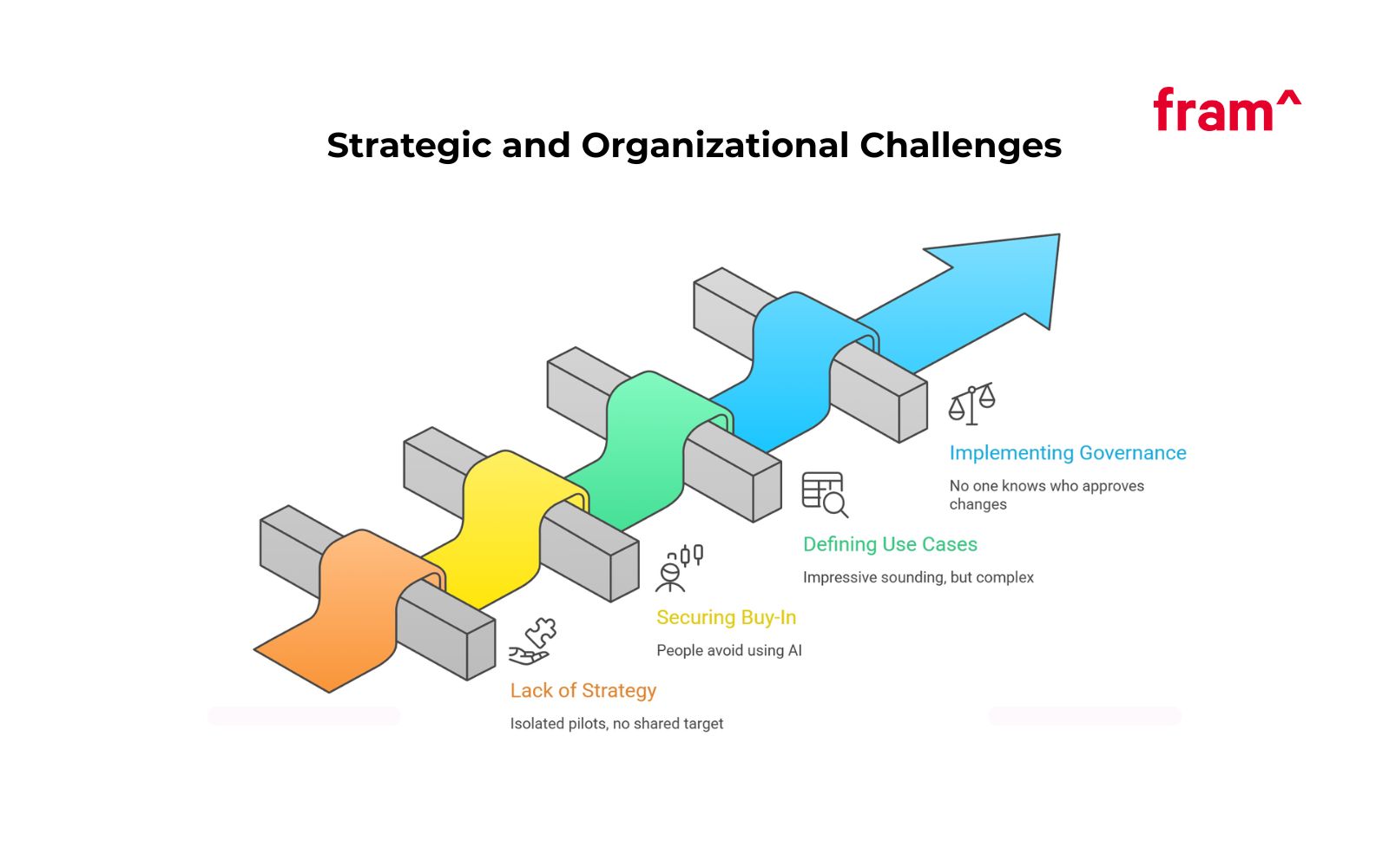
These challenges show up before a model runs in production. Teams lack shared goals, people distrust the change, leaders chase scattered experiments, and nobody owns the decision rights when there is no clear governance structure. Gartner’s 2024 poll found 55% of organizations have an AI board, yet accountability stays spread out, and only a quarter of respondents aligned accountability to a clear role.
Strategy work sounds less exciting, compared to building a demo. However, it saves time later. A clear plan sets owners, defines high-value use cases, funds data work, sets risk rules, and forces trade-offs between speed and safety and ethical considerations. All of which are fundamental for AI tools to work seamlessly.
Lack of Comprehensive AI Strategy
Strategy element
What to decide
Example output
Owner
Success metric
Review cadence
Business goal
What business result AI supports
“Cut claims handling time”
Ops lead
Avg cycle time
Monthly
Scope
Which workflows and teams
Claims intake + triage
Product
% cases in scope
Monthly
Data sources
Systems that feed AI
CRM, ticketing, policy DB
Data owner
Data freshness
Weekly
Delivery path
Pilot → production plan
6-week pilot, 12-week scale
Program lead
Go-live date
Biweekly
Risk limits
Where AI cannot decide alone
Payout approval stays human
Legal + Risk
% human-reviewed
Monthly
Budget
Build and run costs
Infra + vendor + people
Finance
Cost per case
Monthly
Many artificial intelligence programs start with AI tools, not outcomes. That creates a stack of disconnected pilots that never change core workflows. McKinsey reports thatmost organizations remain in experimentation or piloting, with about one-third reporting they have begun to scale AI programs. That pattern matches what many leaders see: curiosity stays high, impact stays narrow.
A comprehensive AI strategy answers four questions in plain language. What business outcomes matter, what data supports them, who owns delivery, and what risk limits apply. Without those answers, teams argue about model choices instead of building usable systems.
How to fix it
Set three business goals tied to metrics, like cycle time, cost per case, or revenue per rep.
Map owners across IT, data, security, legal, and the business, and give them decision rights.
Build a delivery plan that moves from pilot to production with exit criteria.
Publish a model and data inventory, then assign system owners and budgets.
Securing Team Buy-In and Managing Change
AI changes work, not just software. People worry about job security, quality standards, and loss of control. Change resistance kills adoption faster than model drift.
AI programs behave like transformations once they touch frontline workflows. Teams must treat adoption as a management problem, not a technical sprint.
Buy-in requires two things: clarity and safety. Clarity means people understand what changes and what stays. Safety means teams know where humans stay in control, how errors get handled, and how performance gets measured without blame.
How to fix it
Pick one workflow and redesign it end to end, not one isolated AI feature.
Define human review points for high-stakes decisions and publish escalation paths.
Train managers first, then teams, using real internal examples and common failure cases.
Create a feedback loop that tracks errors, rework, and user friction every week.
Learn more about planning your AI solutions effectively in our end-to-end AI guide.
Defining and Prioritizing Your Company’s AI Use Cases
AI value is uneven. Some tasks fit machine learning-based prediction and classification. Some fit retrieval and summarization using natural language processing. Some break under hallucinations, missing context, or weak ground truth. Picking the wrong use case burns trust, then leadership cuts the budget.
McKinsey reports that51% of respondents from organizations using AI say they have seen at least one negative consequence. Nearly one-third report consequences tied to AI inaccuracy. That makes use-case selection a risk control step, not a brainstorming session.
Strong use cases share four traits. Clear input data, a measurable output, a defined decision owner, and an acceptable error cost. Weak use cases lack evaluation data, mix policy decisions with fuzzy text, or require perfect recall from scattered file cabinets and email threads.
How to fix it
Score use cases by value, risk, data readiness, and ability to measure outcomes.
Start with “human-in-the-loop” designs for decisions tied to money, safety, or legal duty.
Build evaluation sets from past cases, then test model outputs against that history.
Create a “do not automate” list for areas where errors cause severe harm.
Tip for scoring: Use a simple total like Value + Data + Fit – Risk, then sort.
Example scoring the use cases
Use case
Business value (1–5)
Risk (1–5)
Data readiness (1–5)
Workflow fit (1–5)
Effort (S/M/L)
Target KPI
Customer email triage
4
2
4
5
M
First response time
Contract clause search
5
3
3
4
M
Review hours saved
Fraud alert ranking
5
5
3
3
L
False positives
Agent assist summaries
3
2
4
4
S
Handle time
Implementing AI Governance and Oversight
Governance sounds slow until something breaks. Then it becomes the only topic. Governance covers model approval, data access, monitoring AI algorithms, incident response, documentation, and audit readiness. It clarifies who can deploy, what must be logged, and who can stop a system.
Gartner found that 55% of organizations have an AI board,and 54% report a head of AI or AI leader. The same Gartner poll notes that only a quarter of respondents aligned accountability to a clear role. That gap produces shadow deployments and unclear risk ownership.
Good governance means a repeatable gate: data checks, model evaluation, security review, and a sign-off tied to the risk level.
How to fix it
Set a tiered governance model: low-risk tools move fast, high-risk tools require deeper review.
Require model cards, data lineage notes, and evaluation results before production access.
Add monitoring for drift, prompt injection patterns, abnormal usage, and output quality.
Run quarterly audits of model access, logs, vendors, and exception approvals.
Technical and Infrastructure Integration Challenges
These challenges appear after leadership says “yes.” The model works in a sandbox, then reality hits: old systems, fragmented data, latency constraints, uptime demands, and the need for secure custom APIs. Teams realize they did not sign up to build a single chatbot. They signed up to build AI-driven processes that interact with production systems.
A useful rule: AI increases integration work.
Integrating AI Into Your Legacy Systems
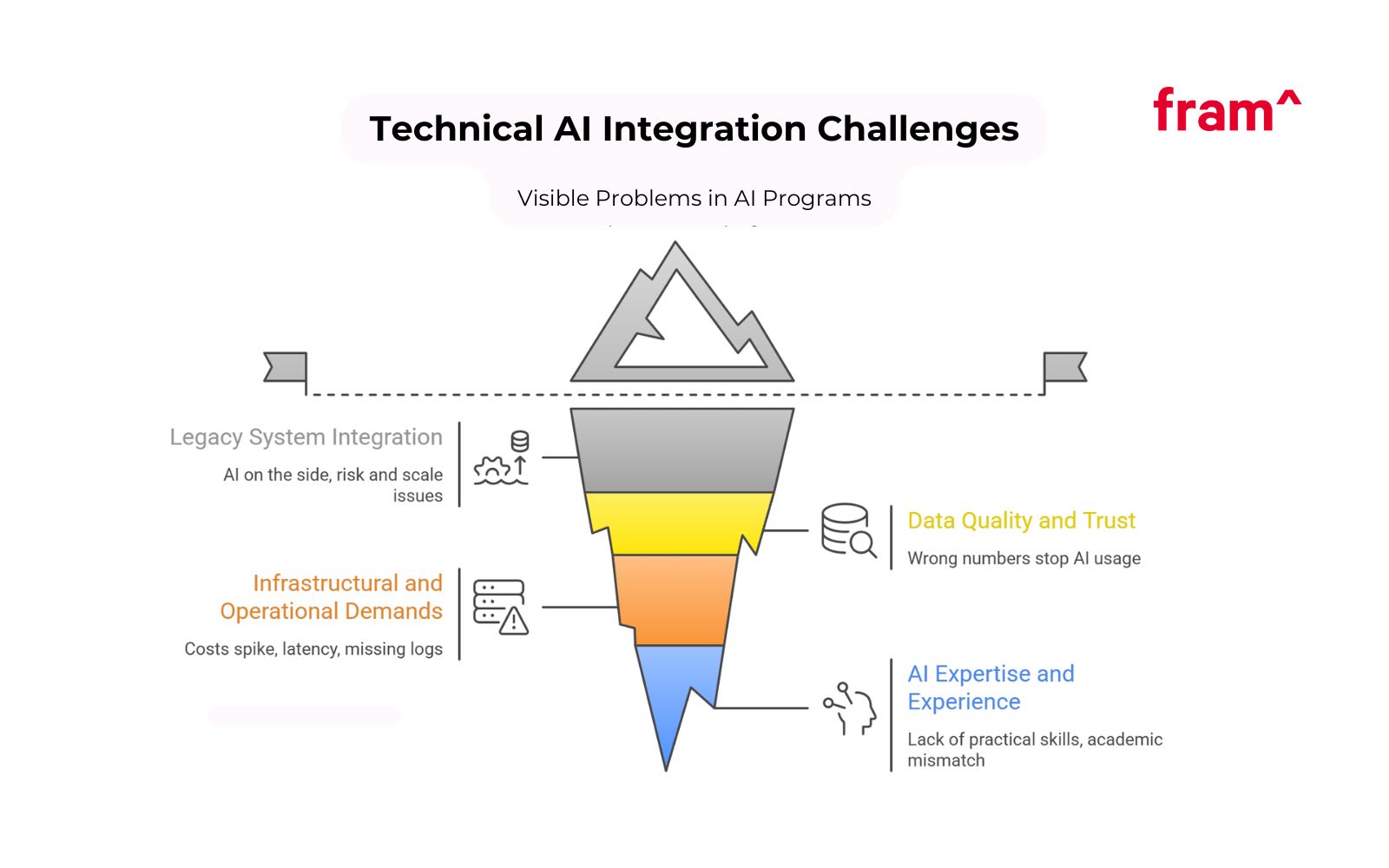
Legacy systems hold critical data and business logic. They rarely expose clean interfaces for modern AI applications. Many firms still rely on brittle batch jobs, shared databases, and manual exports.
A SnapLogic survey reported that 96% of organizations rely on legacy tech to some extent, and75% spend 5 to 25 hours per week updating or patching legacy systems. That maintenance load steals time from AI integration.
Legacy integration fails when teams treat AI as a bolt-on. It succeeds when teams design the integration layer first: identity, permissions, API gateways, event streams, and data contracts.
How to fix it
Build an integration layer with APIs and event streams, then connect models through that layer.
Start with read-only integrations, then add write paths after monitoring proves stable.
Define data contracts and versioning so changes do not break downstream model behavior.
Keep sensitive operations behind explicit human approval and logged actions.
Data Quality, Organization, and Trust
AI runs on data, and most enterprise data is messy. Duplicate records, missing fields, conflicting definitions, and hidden policy exceptions create brittle model behavior. Teams lose trust fast when outputs feel random.
Gartner reports that poor data qualitycosts organizations at least $12.9 million per year on average. Gartner also reports that 59% of organizations do not measure data quality. That means many teams cannot quantify the problem, so they underfund it.
Data trust is not a single cleanup project. It is a system: ownership, standards, lineage, and monitoring. Without that system, teams ship a model, then spend months arguing about whose numbers are “right.”
How to fix it
Assign data owners for key domains, then define shared business definitions for each metric.
Build a data catalog with lineage so teams can trace sources and transformations.
Add automated checks for completeness, duplication, timeliness, and schema drift.
Use retrieval with source citations for knowledge work, so users can verify claims.
And when in doubt, get started on your AI adoption journey with relative confidence with the help of our Trust Progression Framework.
Infrastructural and Operational Demands
When it comes to infrastructure, most teams think “GPU” and stop there. Real AI infrastructure is a stack. You need a place to run inference, and you need predictable performance. That can be a managed API, self-hosted models, or a hybrid setup. Each option has its own trade-offs in latency, data control, and maintenance load.
We also need a retrieval layer for company knowledge. Many generative AI failures come from missing context. To overcome this, the AI infrastructure requires document pipelines, metadata standards, embeddings, and a vector database that stays in sync with source systems.
Then comes orchestration. You need routing, guardrails, prompt templates, tool calling rules, and structured outputs. That orchestration layer becomes the “brain” for AI-driven processes, not the model alone.
You also need identity and logging. Without them, AI becomes shadow IT. Without logs, teams cannot debug bad outputs, trace data access, or pass audits.
What operations looks like after the pilot
A pilot can tolerate glitches. A production workflow cannot.
Ops work starts with service targets. Define latency goals, uptime goals, and acceptable error rates. Tie them to a business workflow, not a model benchmark.
Monitoring must cover more than uptime. Track quality, drift, and user corrections. Track abnormal spikes in usage. Track retrieval failures and empty context returns. Track how often humans override the output. Those signals tell you what is breaking first.
Release management matters too. AI changes often. Prompts change, tools change, data sources change, and models change. Without version control and staged rollouts, teams ship regressions into daily work.
Where cost fits, and why it spikes
Cost is a result of the infrastructure choices above. The IEA projects electricity consumption from data centres couldrise from about 415 TWh in 2024 to 945 TWh by 2030.
Inference cost rises with volume, model size, and response length. Retrieval adds storage and indexing costs. Logging adds retention and security overhead. Human review adds time cost, and it is easy to undercount.
Teams can control cost once they measure unit economics. Track cost per request, c
AI adds new operational loads: GPU capacity, vector stores, prompt routing, monitoring pipelines, and secure storage for logs and evaluation data. Costs climb as usage grows as data volume expands, and latency targets get tighter once AI sits inside daily workflows.
Energy and capacity trends show the direction. The IEA projects electricity consumption from data centres couldrise from about 415 TWh in 2024 to 945 TWh by 2030. That growth tracks rising compute demand from AI, cloud growth, and always-on digital services.
Operational maturity matters more than the model choice. A team with strong observability, incident response, and cost monitoring will outperform a team that relies on ad hoc scripts.
How to fix it
Start with a reference architecture: inference, retrieval, orchestration, identity, logging, monitoring.
Set service targets for latency and uptime, then build alerts around them.
Create an evaluation set from real internal cases, then run it on every release.
Add feature flags and rollback steps, so teams can disable risky behavior fast.
Measure unit economics from week one, then cap usage where value is low.
AI Expertise and Experience
AI programs need product thinking, data engineering, machine learning engineering, security, and domain expertise. Many teams hire one data scientist and expect miracles. That fails. AI work crosses disciplines, so teams need a skilled group with clear roles.
The World Economic Forum reports that44% of workers’ skills will be disrupted in the next five years, and six in 10 workers will require training before 2027. That training demand hits AI programs directly: teams need employee training programs, not only expert hires.
Skill gaps show up in evaluation and operations. Teams can build a demo, but they struggle to validate outputs, manage drift, and run safe deployments.
How to fix it
Build a cross-functional AI product squad with business, data, engineering, and security roles.
Create internal training tracks for prompt use, data literacy, and model evaluation basics.
Standardize tooling for experiments, evaluation, deployment, and monitoring.
Pair internal teams with experienced external experts for the first production releases.
AI Risk and Compliance Challenges
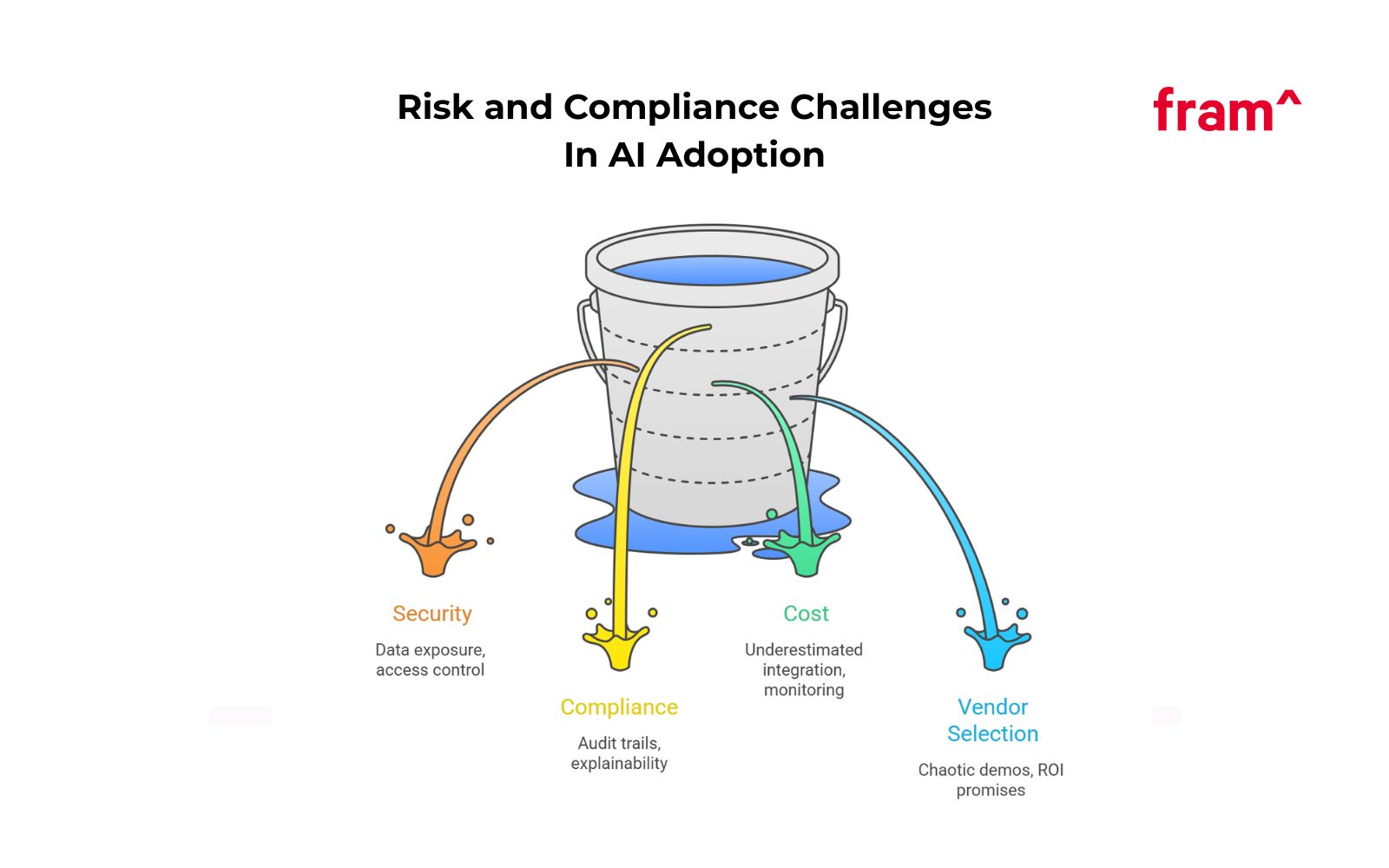
AI raises old risks in new forms. Data breaches now include model access and AI supply-chain compromise. Compliance teams now ask about training data, retention, explainability, privacy laws, audit logs and AI ethics. Legal teams worry about IP and contract terms. Security teams worry about shadow AI use and unmanaged custom APIs.
Ignoring these risks does not speed adoption. It creates rework and shutdowns.
Security and Industry Compliance
Risk scenario
Control
Owner
Evidence to store
Review cadence
Prompt injection
Input filtering + tool allowlist
Security
Test results + logs
Monthly
Data leakage
PII redaction + access policy
Security + Legal
DLP report
Monthly
Wrong answer used as fact
Human review gate
Business
Approval logs
Weekly
Vendor data use
Contract restriction
Legal
Signed DPA
Annual
Model drift
Monitoring + re-eval
AI lead
Eval dashboards
Monthly
AI systems expand the attack surface. Attackers target prompts, retrieval sources, model endpoints, plugins, and identity tokens. Regulated industries face extra pressure around privacy, records retention, and access controls.
IBM’s Cost of aData Breach Report 2025 reports a global average breach cost of USD 4.44 million. The same report says 13% of organizations reported breaches involving their AI models or applications, and 97% of those lacked proper AI access controls. It also reports that 16% of breaches involved attackers using AI.
These numbers point to a simple truth. AI adoption is outpacing oversight in many firms. Security and compliance must become part of the build process, not a gate at the end.
How to fix it
Treat model endpoints like sensitive apps: strong identity, least privilege, and full logging.
Validate prompts and retrieval inputs, then block unsafe tool calls and risky data access.
Add data retention rules for prompts, outputs, and embeddings, tied to compliance needs.
Run vendor reviews that cover data handling, sub-processors, breach notice terms, and audits.
Implementation Cost and Vendor Selection
AI cost is not one line item. It includes data work, integration work, infrastructure, security, training, monitoring, and ongoing evaluation. Vendor choices can lock in cost patterns for years.
Gartner predicted that at least30% of generative AI projects will be abandoned after proof of concept by the end of 2025, citing factors such as poor data quality, inadequate risk controls, and rising costs. Gartner also notes that generative AI deployment costs canrange from $5 million to $20 million, depending on the deployment path and scope.
Vendor selection fails when teams buy AI tools or platforms before they define workflows, data needs, and evaluation rules. It succeeds when teams set requirements first, then run a short, measurable bake-off.
How to fix it
Define total cost of ownership: build, run, monitor, train, and secure over 12 to 24 months.
Run a structured pilot with success metrics, red-team testing, and clear exit criteria.
Negotiate contracts that cover data ownership, retention, model training restrictions, and audit rights.
Decide build vs buy per use case, not per company, then mix off-the-shelf and in-house work.
How to Successfully Navigate These AI Adoption Challenges
AI adoption works when leaders treat it like a product program with risk controls. That means clear use cases, disciplined data work, strong integration, governance, and a plan for human work redesign. It also means measuring outcomes with the same seriousness as any other investment.
Here is a practical playbook that fits most companies.
Set foundations that support scale
Build a roadmap that names owners across business, data, security, IT, and legal.
Create a use-case intake process that scores value, risk, and data readiness.
Define evaluation standards for quality, safety, and human review points.
Run pilots that can become production
Pick one high-value workflow and redesign it with AI built into the steps.
Use retrieval with source attribution for knowledge work and policy-heavy tasks.
Log prompts, outputs, user actions, and model versions for audit and debugging.
Build internal capacity
Launch employee training programs tied to real workflows and real data.
Create templates for model cards, evaluation plans, and deployment checklists.
Form a small platform team that supports squads with shared tooling and guardrails.
Where external experts deliver real value
AI adoption succeeds on strategy, data integration, risk management, and organizational change. And while your internal teams know the business, external experts bring the patterns, capacity, and specialized experience to execute faster.
Working with experts like fram^ accelerates progress in four areas:
Strategy and operating model design: Turn AI ambition into a clear portfolio of use cases with defined decision rights, guardrails, and success metrics. You move from “we should use AI” to a concrete roadmap your executives understand and support.
Integration and data infrastructure: Build the ingestion pipelines, event streams, and secure APIs that connect models to your existing systems. This plumbing determines whether your AI tools feel seamless or bolted-on.
Evaluation, monitoring, and cost controls: Define measurable success criteria, instrument for drift and failure modes, and track unit economics as usage scales. You catch problems early and maintain budget control.
Production pilot acceleration: Take one or two high-value use cases from concept to stable deployment. Use those working examples as templates for the rest of your organization.
If you’d like to learn more, fram^’s AI whitepaper expands on architecture choices, governance patterns, and rollout models. Download and share it internally as your alignment document! The whitepaper covers infrastructure decisions, risk frameworks, and organizational patterns teams apply when scaling AI beyond prototypes.
Accelerate your progress with implementation support – fram^’s AI implementation services help you execute:
Map your systems and data into an AI-ready architecture
Design and build the pipelines and APIs behind your first production use cases
Set up evaluation and monitoring to surface issues before they reach customers
Train internal teams to own and extend the solutions over time
Automated ticket triage is the process of using software to sort, tag, prioritize, and route incoming support tickets with minimal human effort. It turns the first mile of support into a repeatable system. The goal stays simple: get the right ticket to the right team fast, with the right context. Most support teams feel the […]
AI integration works best when product teams start with one measurable workflow, choose the simplest technical pattern, and pilot the feature before full rollout. Artificial intelligence improves software in specific, measurable ways: sharper search, generative content, real-time recommendations, and faster support. But none of those happen by accident. Every gain comes from applying machine learning […]
Every AI coding tool ad ends at the same place: a working product in 48 hours. What they skip is week eight, when real users arrive, payment flows fail silently, and an enterprise prospect asks for your SOC2 documentation. If you’re reading this, you may be somewhere in that gap. Maybe you tried Lovable, Cursor, […]