AI Implementation Roadmap: Plan, Deploy, and Safely Scale Your Business
March 18, 2026
Artificial intelligence (AI) has moved from experiment to expectation. Boards ask about AI strategy. Product teams test AI use cases in parallel. Customers start to prefer AI-powered experiences that feel fast, personal, and reliable.
In that rush, many organisations jump from idea to tool selection and skip the hard planning work. An AI implementation roadmap stops that pattern. It links AI initiatives to business value, sets clear responsibility, and reduces AI risk.
Table of Contents
Get Started on your AI Implementation Roadmap
AI Implementation Roadmap: Key Takeaways
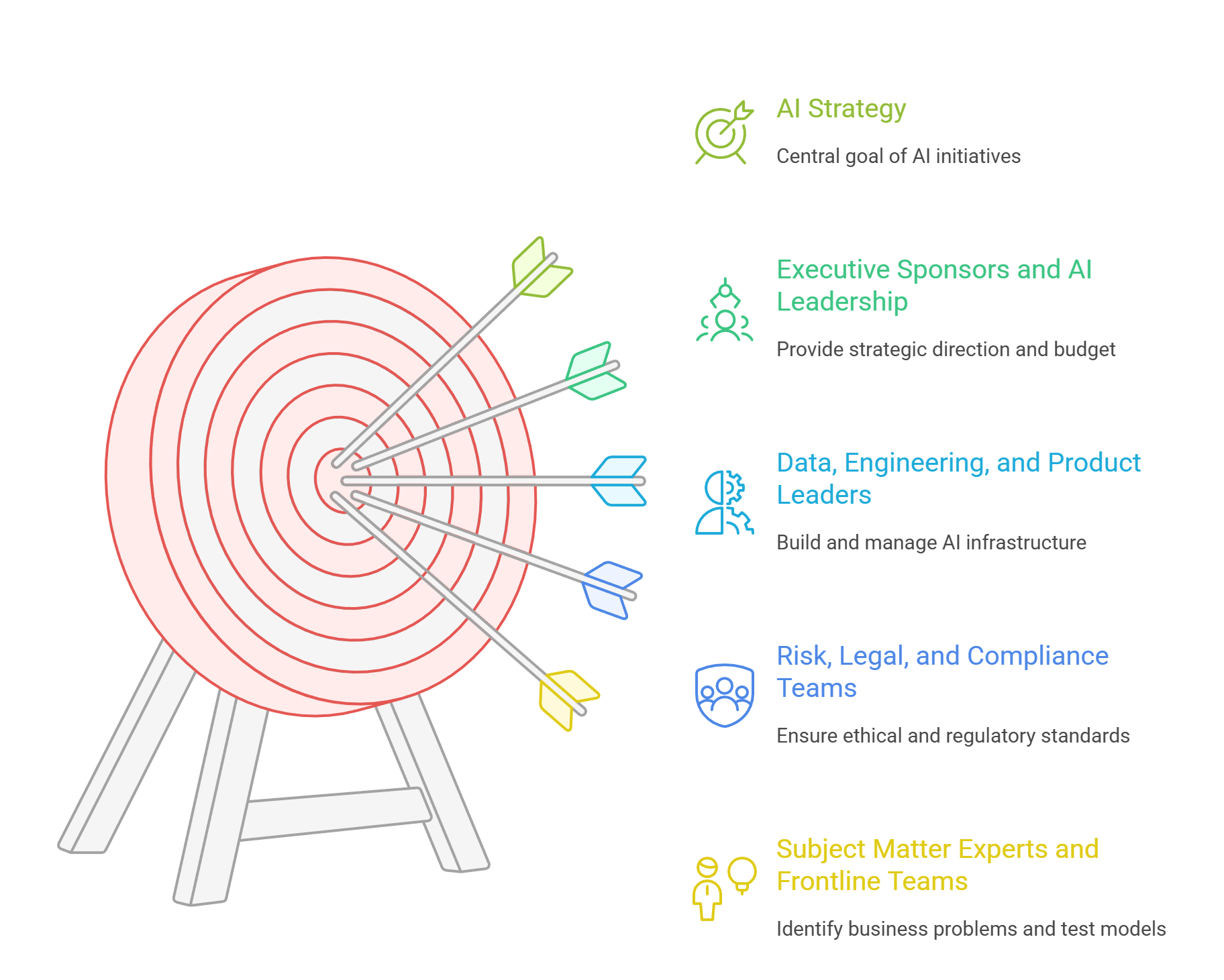
AI strategy starts with people and business value, not with tools. Bring executive sponsors, data leaders, subject matter experts, and risk teams into one AI governance structure.
Pick AI initiatives that link to clear business outcomes and real business processes. Check data feasibility and AI risk early.
Invest in data readiness. A short AI data preparation checklist does more for AI maturity than many long policy documents. Use it for every new project.
Build a lean AI execution team that covers product, data, engineering, MLOps, and change management. Extend it with partners as needed.
Treat pilots as learning tools. Test AI models, AI governance, and change management in a safe but realistic setting.
Plan for long-term operation. Monitor AI applications, retrain when needed, and keep documentation and AI policies current.
Who Should Be Involved in Your AI Strategy Planning?
AI is no longer only a research topic or a side project for a data scientist. Every serious AI strategy touches revenue, cost, risk, and reputation. That means AI planning needs a broad set of voices, not just a small technical group.
A clear AI governance structure sets this up. It defines who makes decisions, who owns AI risk, and how AI investment gets approved. The mix will vary by company size and sector, yet most successful AI organisations share a common pattern of stakeholders.
Executive sponsors and AI leadership
Artificial intelligence changes how work gets done and how decisions are made. That change rarely happens without visible support from senior leaders.
You need at least one executive sponsor with budget authority. In larger organisations, this sponsor may sit in a Chief AI Officer role, or as part of the CIO, CDO, or Chief Product Officer remit. Their tasks include setting AI strategy, aligning AI use cases with organisational strategy, and reporting AI impact in terms that boards understand, such as margin, revenue, or public value.
This group signs off on AI policies, approves AI risk thresholds, and backs the change management needed for adoption.
Data, engineering, and product leaders
AI capabilities depend on an AI data foundation and production-ready systems. That calls for close work between data leaders, engineering leadership, and product owners.
Data leaders oversee Data Governance, Data Quality Management, and data management processes. They define how the organisation treats AI data across ingestion, storage, transformation, and access.
Engineering leaders own cloud infrastructure, deployment pipelines, and system reliability. Product leaders translate AI models into real AI applications that improve customer experience and internal workflows.
Risk, legal, and compliance teams
AI governance fails if it ignores regulatory compliance and ethical standards and governance. Risk, legal, and compliance teams bring that lens.
They track AI in 2025 and beyond from a regulatory view, including AI-related acts, data privacy laws, and sector-specific rules in finance, healthcare, and government. They help define acceptable AI use cases, review AI algorithms for any model bias detection, and set rules on data retention and monitoring.
Their early involvement reduces the chance of blocked launches or public incidents later.
Subject matter experts and frontline teams
AI strategy often fails not due to technology, but due to a weak understanding of real business processes. Subject matter experts in sales, operations, customer success, finance, or clinical work know where friction sits.
Involve them in problem discovery, AI use case design, and evaluation of AI models. Their feedback shapes prompts, workflows, UX, and guardrails. They help translate AI impact into better customer experiences and simpler processes.
External partners and AI ecosystem
Few organisations can staff every AI skill from day one. External partners fill gaps and share patterns from other sectors.
Fram^ can help with AI readiness assessments, AI strategy design, and hands-on AI implementation. Vendor partners provide AI technology such as large language models, MLOps platforms, and Data pipeline platforms. Industry alliances, research consortium groups, and industry conferences add another layer by sharing common practices and building public value.
Your AI ecosystem should sit inside your AI governance structure, not outside it. Treat partners as part of a wider SS&C | Blue Prism® Enterprise Operating Model style view of people, process, and technology.
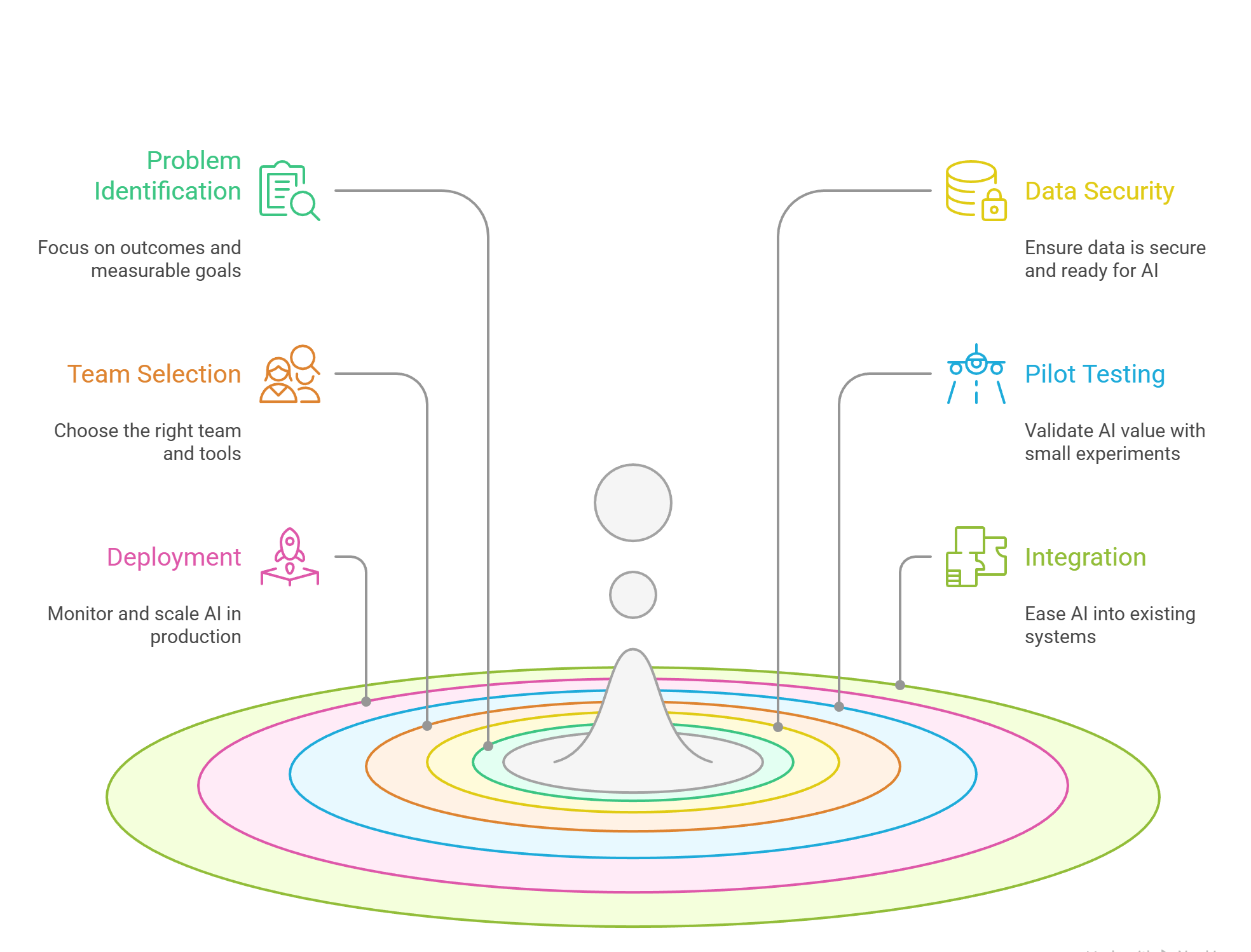
1: Identify the Problem That Can Be Most Effectively Solved With AI
Strong AI strategies start with a clear problem. They avoid the trap of starting with a model or tool and then hunting for a use case.
AI technology has strengths and weaknesses. It excels at pattern recognition, Natural Language Processing, and prediction tasks where there is enough data. It struggles in areas with little data, rapidly shifting rules, or high stakes with low tolerance for error and drift.
Your job in this stage is to map where AI can add business value with acceptable AI risk.
Start from business outcomes and customer experience
First, pick a concrete outcome. That can be faster response times, higher conversion, lower manual effort, better fraud detection, or better citizen service. Link this outcome to metrics that you already track.
Then look at the customer journey or internal process behind that outcome:
Where do delays happen?
Where do people repeat the same judgment calls?
Where do teams copy data between systems?
AI use cases that reduce these points of friction create clear stories for stakeholders and give you a baseline for measuring AI impact.
Match AI strengths to problem types
Next, link each problem to AI strengths. For example:
Classification and prediction with Machine Learning and Deep Learning for churn, risk scores, or demand forecasting.
NLP with AI algorithms for routing tickets, extracting entities from documents, or summarising calls.
Generative AI for drafting content, code suggestions, or knowledge base answers.
Recommendation models for product suggestions or content feeds.
Check whether the problem fits with available AI models and training data. If you need a custom neural network that requires years of labelled data and you have only a small dataset, you may need a different path, such as rules or traditional analytics.
Evaluate feasibility, complexity, and constraints
Not every attractive AI application makes sense as a first project. Rate each candidate problem on three axes.
First, feasibility. Do you have access to relevant AI data? Can you ingest it from the current systems?
Second, complexity. Does the project involve many legacy systems, several teams, or high integration complexity?
Third, constraints. Think about regulatory requirements, expected scrutiny from customers or regulators, and tolerance for error. Some AI initiatives fit better as internal tools than as first-line customer-facing features.
This evaluation shapes your initial AI Roadmap and helps focus early AI investment where success is most likely.
Check compliance and ethical boundaries
AI adoption happens within law and ethics, not outside it. Review sector rules for AI, data protection, and model transparency. Map these to internal AI policies on fairness, transparency, and safety. And be sure to check out our guide on AI adoption challenges to avoid some of the common pitfalls.
For each shortlisted AI use case, ask whether it requires human-in-the-loop (HITL) review, logging for audit, or specific consent flows. This early work prevents painful rework during deployment.
2. Ensure Your Data Is Secure and Ready
AI implementation stands or falls on data readiness. Many AI projects stall when teams discover that key data is hard to access, missing, or unreliable.
You need a clear view of your data inventory, accessibility, data quality, labeling, and data governance before you move deep into AI model work. Clean AI data and clear Data Governance reduce AI risk and shorten project timelines.
Download our AI Data Preparation Checklist here!
Map your data inventory and access paths
Start with a simple data inventory tied to the AI use cases you picked. List which CRMs, ERPs, product databases, data warehouses, data lakes, and SaaS tools hold relevant AI data. Note storage locations in cloud infrastructure and on-premises systems.
Then map how teams can reach this data. Check whether you have APIs, SQL access, or a Data pipeline platform that covers ingestion and Data Transformation. Look for silo problems where a team owns data, but others need to request extracts through manual steps.
A strong AI strategy makes access predictable, secure, and documented.
Raise data quality and governance
AI models amplify data problems. If your data is incomplete, inconsistent, or out of date, model outputs will reflect that.
Set up simple Data Quality Management routines. Profile key tables for missing values and extreme outliers. Check for duplicates and inconsistent identifiers across systems. Clean the worst problems first, then document data lineage and common transformations.
At the same time, formalise data management processes. Agree on who owns which data sets, how changes to schemas get approved, and how new data sources enter your AI ecosystem. Even simple written rules help.
Good AI governance sits on this base. It treats data as a managed asset, not an afterthought.
Address privacy, security, and compliance
AI use often blends many datasets. That raises fresh questions for privacy, security, and regulatory compliance.
Classify data by sensitivity level. Mark personal, financial, clinical, or strategic data with clear labels. Map data flows across systems and confirm that encryption, access controls, and logging match your internal policy and sector rules.
For each AI model, record what data it uses in training and in inference. That supports future model drift investigations and simplifies audits.
Build and share an AI data preparation checklist
Checklists help teams repeat good practice. An AI data preparation checklist gives product managers, data engineers, and business owners a shared view of what “AI-ready data” means in your organisation.
The checklist you use can cover topics such as data inventory, accessibility, quality, security, and labelling.
3. Choose Your AI Execution Team and Tools
With early problems and data readiness in view, the next question is who will build and run AI solutions and which tools they will use.
This stage covers AI organization design, the people, process, and technology framework for AI work, and the platforms needed for reliable AI deployment.
Decide on in-house, hybrid, or partner-led execution
Some organisations build an internal AI organisation with data scientists, AI engineers, and product teams. Others rely on partners. Many pick a hybrid pattern.
Factors that shape this choice include the strategic importance of AI, access to talent in your region, budget for AI investment, and time pressure. A core internal team with product, data, and engineering skills often works best, with external partners adding capacity and specialised skills.
Partners like fram^ can bring ready-made teams for AI implementation, MLOps, and integration with legacy systems, without long-term headcount. This model helps you move fast while you build internal AI maturity.
Define the key roles across people, process, and technology
An effective AI execution team covers more than model building. Core roles include:
Product owner, who ties AI initiatives to business outcomes and manages the backlog.
A ‘solutions’ architect, who designs the AI solution across data ingestion, AI models, and consuming applications.
Data engineers, who build and maintain data pipelines, data Ingestion, storage, and AI transformations.
Data scientists and ML engineers, who design, train, and fine-tune models across Machine Learning, Deep Learning, and large language models.
MLOps engineers, who own deployment pipelines, monitoring, and rollback.
QA and security engineers, who test AI behaviour, performance, and security.
Change management and training leads, who prepare teams for new AI applications.
This structure mirrors operating models such as the SS&C | Blue Prism® Enterprise Operating Model, which link people, process, and technology in a clear way for automation and AI work.
Choose the AI technology stack
The AI technology stack should support your target AI use cases without locking you into a single path. You can think about it in layers.
At the base sits cloud infrastructure and data platforms. You need storage that fits your scale and performance targets, along with processing engines for data transformation and training.
Above that sits a layer for Machine Learning and AI models. This might include open source libraries, managed services for AutoML, and access to large language models via APIs. You may add vector databases for retrieval augmented generation, or specialised tools for computer vision.
On top of that sits MLOps and application integration. MLOps platforms help teams manage experiments, model registries, deployment pipelines, and rollbacks. Application teams connect AI services to CRMs, ERPs, web apps, mobile apps, and internal tools through APIs and SDKs.
Plan AI investment and governance for tools
Tool choice carries cost and risk. You need a simple process for approving new AI tools, tracking contracts, and comparing usage to value.
Set standards for security, data control, and vendor lock-in. For each tool, record who owns it, what AI initiatives depend on it, and what policies apply.
This level of discipline supports AI governance and reduces surprise renewals or unused tools.
4. Test With a Small MVP, Prototype, or Pilot Program
Your AI Strategy Roadmap becomes real through experiments. A small MVP or pilot project turns abstract AI use cases into working systems that teams can touch and test. And don’t miss our comparison of AI MVPs vs traditional ones for a full breakdown.
The goal is to reduce uncertainty across AI models, data, process changes, and adoption. Pilots give you evidence on AI impact and AI risk before large deployments.
Define success criteria and metrics early
Before you build, write down what success looks like. Tie it to existing metrics in your business.
For example, a customer service automation may target a drop in average handling time, a higher self-service rate, and stable or better customer satisfaction scores. A demand forecasting model may target lower stockouts and lower surplus stock.
Set target ranges and timeframes. Include both direct metrics and guardrail metrics such as error rate, complaint volume, or manual override rate.
Design a minimal yet realistic AI use case
Pilot projects should be small in scope but real in context.
Limit the number of workflows or customer segments in the first release. Use real user data, real interfaces, and real production AI systems where possible, with clear safeguards and monitoring.
For generative AI, start with narrow prompts tied to a clear context window, such as internal knowledge base articles or a set of product specifications. For predictive AI, pick a limited product line or region for early use.
Build feedback loops and AI governance into the pilot
Pilots offer a chance to test AI governance in practice. Plan how you will capture feedback, review incidents, and decide on changes.
Set up regular review meetings that include product, data, engineering, and risk teams. Track model performance, error cases, and user comments. Where AI outputs are wrong or unsafe, trace back through the data pipeline and model configuration to find root causes.
Use this data to refine AI applications, update AI policies, and improve training data.
5. Deploy, Monitor, and Scale
Once a pilot shows real AI value and acceptable risk, attention shifts to production deployment and scale. Many organisations underestimate this stage. Yet it is where AI applications live for years and where most cost and risk sit.
You need clear practices across deployment pipelines, monitoring, retraining, and communication with stakeholders.
Move from pilot code to production systems
Pilot code often contains shortcuts. Before broad deployment, review the full stack.
Harden data pipelines with validation, retry logic, and observability. Review AI models for resource usage and latency. Plan how services will scale under load and what fallbacks exist if a model or an upstream service fails.
Document runbooks for incident response. Train support teams on common AI-related issues so they can respond quickly.
Monitor performance, drift, and AI risk
AI models change behaviour over time as input data shifts. This model drift can erode performance in quiet ways.
Set up monitoring for both technical and business metrics. Track latency, error rates, and resource usage. Track business metrics tied to the AI application, such as accuracy, acceptance rate, or financial impact.
Add checks for data drift, such as distribution shifts in key features or changes in text inputs over time. When drift appears, investigate whether it needs retraining, prompt changes, or product changes.
Operate AI responsibly day to day
AI governance is not a one-time project. It shows up in daily work.
Define clear responsibility for each model and AI application. Record who can approve changes, who can push deployments, and who reviews incidents.
Maintain an inventory of AI models, AI applications, and related AI policies. Include links to technical documentation, risk assessments, and compliance checks. This supports internal data audits and external reviews, and builds trust with internal and external users.
6. Ease Integration Into Your Existing Systems
Few organisations start AI on a greenfield stack. Most have legacy systems, complex ERPs, and CRMs with years of custom logic. AI solutions need to fit into that environment without breaking what already works.
Thoughtful integration planning speeds AI product deployment and makes adoption easier for non-technical stakeholders.
Work carefully with legacy systems
Legacy systems often hold the most valuable AI data. They may lack modern APIs or event hooks.
Begin with a mapping exercise. List main systems, their data, their entry points, and their constraints. Look for modernisation efforts already planned and coordinate AI work with them.
Where direct integration is hard, consider middle layers that sync data into more modern stores or message queues. Aim to reduce tight coupling, so AI services can evolve without constant deep changes in legacy code.
Design usable AI applications for non-technical teams
AI only creates business outcomes if people use it. Non-technical teams need interfaces that feel clear and trustworthy.
Embed AI into tools people already use, such as CRM screens, ticketing systems, collaboration tools, or internal portals. Present AI suggestions, predictions, or generated content in a way that shows context and allows human override.
Explain what the AI application does and does not do. Simple, honest descriptions build AI culture and trust more than vague claims.
Plan for AI change management
AI change management deserves as much attention as AI models. It covers communication, training, role design, and support.
Tell teams early what will change in their daily work and why. Offer training that focuses on real tasks, not only on theory. Provide clear ways to report issues and give feedback on AI applications.
Align incentives so that people feel rewarded for using AI responsibly. Include AI use in role descriptions and performance conversations where it makes sense.
Reach Your Destination
An AI implementation roadmap is not a fixed script. It is a living plan that ties AI strategy to business value, aligns stakeholders, and guides daily work on AI initiatives.
You start by bringing the right people into AI strategy planning and defining clear AI governance. You identify problems where AI can deliver strong business outcomes and match them to AI strengths. You get AI data ready, design an AI organisation with the right skills and tools, and run focused pilots that test both technology and process.
Then you deploy with care, monitor AI impact and AI risk, and integrate AI into existing systems in a way that feels natural for teams and customers. At each step, you refine your AI Strategy Roadmap as you learn more about your own AI readiness and AI culture.
Expert partners can shorten this path. Fram^ can support AI assessments, microservices architecture, and delivery, and can bring experienced AI engineers, data scientists, and solution architects into your AI organisation when you need them.
Download our AI Data Preparation Checklist here!
To help your team act on this AI roadmap, create a shared AI data preparation checklist based on the themes in this guide. Turn it into a simple, visual document that teams can review in under ten minutes before any new AI project.
If you work with fram^, you can request an AI data preparation checklist that covers data inventory, accessibility, quality, compliance, and labelling, ready to adapt to your own AI organisation.
Want to make sure your team is AI-ready. Share this roadmap with your stakeholders, agree on your first AI use case, and start by walking through the checklist together.
Automated ticket triage is the process of using software to sort, tag, prioritize, and route incoming support tickets with minimal human effort. It turns the first mile of support into a repeatable system. The goal stays simple: get the right ticket to the right team fast, with the right context. Most support teams feel the […]
AI integration works best when product teams start with one measurable workflow, choose the simplest technical pattern, and pilot the feature before full rollout. Artificial intelligence improves software in specific, measurable ways: sharper search, generative content, real-time recommendations, and faster support. But none of those happen by accident. Every gain comes from applying machine learning […]
Every AI coding tool ad ends at the same place: a working product in 48 hours. What they skip is week eight, when real users arrive, payment flows fail silently, and an enterprise prospect asks for your SOC2 documentation. If you’re reading this, you may be somewhere in that gap. Maybe you tried Lovable, Cursor, […]