Go vs Java for Microservices: A Developer’s In-Depth Performance Comparison
December 3, 2024
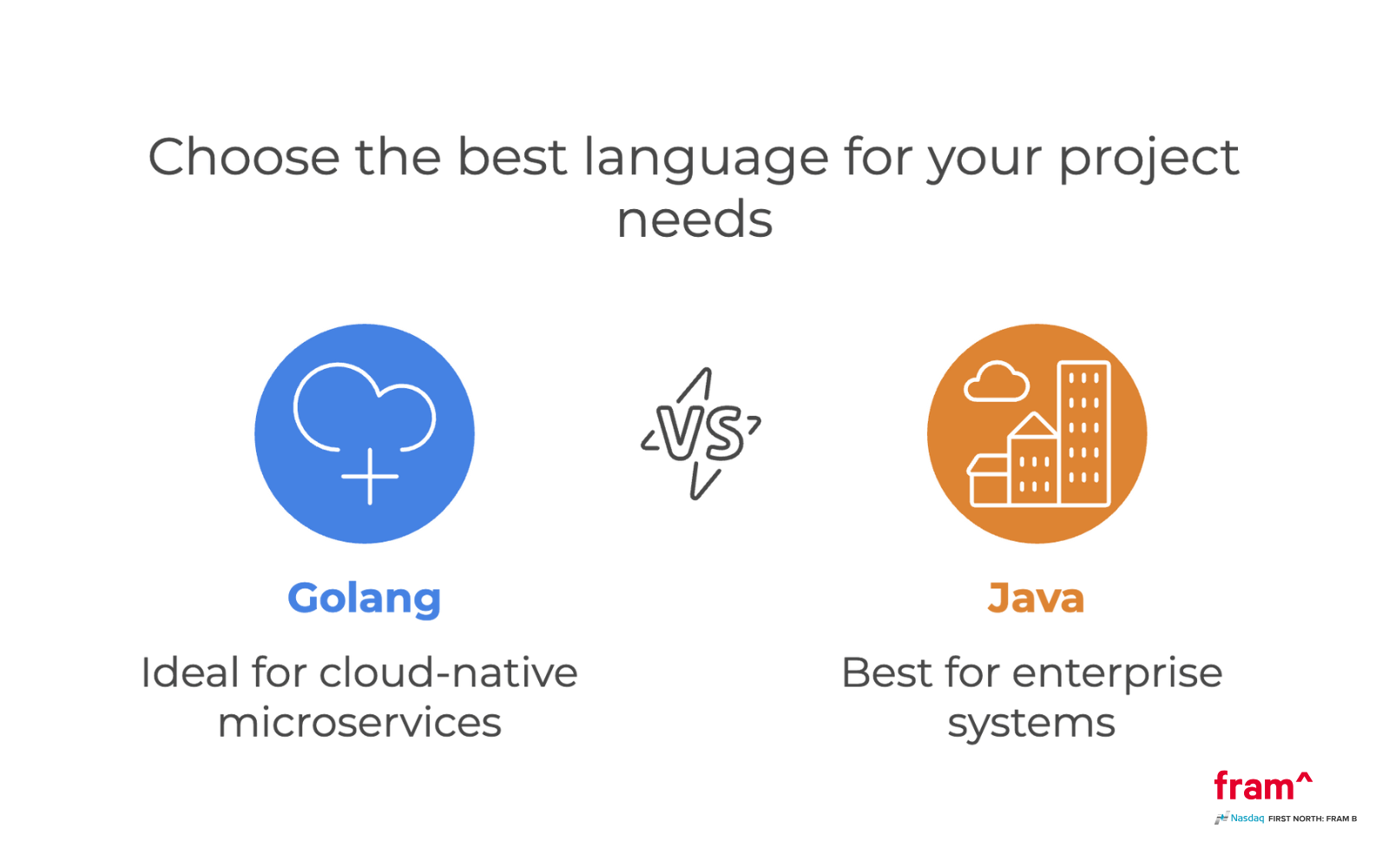
Go and Java are both strong backend languages, but they solve different problems particularly well. In microservices architectures, Go is often favoured for lightweight, cloud-native services with fast startup times and lower memory overhead, while Java remains a strong choice for systems with more complex business logic, deeper enterprise integrations, and mature framework needs.
This article focuses specifically on Go vs Java for microservices. It is not a general language comparison. Instead, we’ll look at how the two languages differ in areas that matter most for modern backend teams, things like performance, concurrency, scalability, cloud-native fit, maintainability, and long-term tradeoffs.
Table of Contents
Key Takeaways Comparing Golang vs Java
Go and Java are both strong choices for microservices, but they solve different problems well. Go is often a better fit for lean, cloud-native services, while Java remains strong for complex, enterprise-oriented systems.
Performance is not one score. In microservices, the better choice depends on startup time, memory usage, latency, throughput, and operational overhead, not just benchmark headlines.
Go often has the edge when simplicity and efficiency matter most. It is well suited to lightweight services, fast startup, lower memory usage, and Kubernetes-aligned environments.
Java often has the edge when business complexity matters more than runtime simplicity. Its mature frameworks, enterprise tooling, and broader hiring pool make it a strong fit for larger, more integrated systems.
The real decision is often about long-term tradeoffs, not language preference. Over time, cost to operate, ease of evolution, and ease of staffing can matter more than syntax or developer taste.
For most microservices teams, the best choice is the language that fits the workload, the architecture, and the team they want to build.
What is Golang (Go)?
Golang, or Go, is a modern, compiled programming language designed for speed, simplicity, and scalability.
Created by Google, Go has gained popularity for its efficiency in cloud-native development, system programming, and lightweight mobile apps.
Its rich standard library makes it easy to develop robust applications without relying on extensive external dependencies.
Why Golang is Good for Microservices
Golang’s strengths align well with the needs of microservices, especially in terms of performance, concurrency, and simplicity.
Designed for efficiency and scalability, Go has gained traction for cloud-native applications. Low memory consumption and high-speed performance are essential (check out the various performance tests we like to run for our projects). Its strong community continues to expand the ecosystem, supporting developers in building scalable, secure systems.
Advantages of Using Golang for Microservices
Fast Execution: Go’s compiled nature enables it to run fast, a critical feature for microservices responding quickly under heavy loads.
Concurrency Model: Go’s goroutines make handling simultaneous requests efficient and lightweight, making it a strong fit for handling concurrent microservices.
Low Memory Consumption: Microservices benefit from Go’s low memory usage, which improves server efficiency and reduces hosting costs.
At Fram, we use Golang for building lightweight, high-performance microservices due to its speed and scalability, especially for cloud-based applications (learn all about the pros and cons of cloud computing).
Challenges of Using Golang for Microservices
Limited Libraries: While Go’s ecosystem is growing, it still lacks the vast library resources available in Java, which can require more time for building complex microservices.
Evolving Generics Support: Go added generics in version 1.18 (March 2022). The feature reduces boilerplate for collections, data structures, and type-safe utilities. Teams migrating from Java find Go’s implementation simpler but more constrained. Type parameters use interface-based constraints instead of Java’s bounded wildcards. Complex patterns like recursive type bounds work differently or require workarounds.
What is Java?
Java is a relatively mature, object-oriented language known for its stability, cross-platform capabilities, and vast ecosystem.
Since 1996, Java has evolved into one of the most popular languages for mobile apps, enterprise systems, and large-scale microservices.
Its extensive features, such as automatic memory management and robust libraries, make it reliable for building secure, scalable applications.
Why Java is Good for Microservices
Java’s robustness and maturity make it a popular choice for complex, large-scale microservices. With frameworks like Spring Boot,
Java is a proven technology in enterprise environments where stability and extensive library support are necessary.
Advantages of Using Java for Microservices
Established Frameworks: Frameworks like Spring Boot simplify microservice development, providing built-in tools and resources to speed up deployment.
Cross-Platform Flexibility: Java’s Virtual Machine (JVM) makes it highly portable and ideal for distributed systems that may run on different operating systems.
Mature Ecosystem: Java’s ecosystem is extensive, with libraries and community support for almost any functionality, which can simplify development for complex microservices.
At Fram, we use Java to develop reliable, scalable enterprise microservices because it provides the necessary stability and tools for complex systems.
Challenges of Using Java for Microservices
Higher Memory Usage: Java consumes more memory, which can be a drawback for microservices that aim to minimize server resources.
Slower Startup Times: Java applications may experience slower startup due to JIT compilation, which can impact scaling performance in dynamic environments.
Operational health & observability: Java applications run on the JVM, which can keep the OS process alive even after serious failures like OutOfMemoryError. Process-level checks like “is it running?” miss application-level failures. As recommended in the Health Probe chapter of Kubernetes Patterns 2nd edition, you need health endpoints and proper liveness/readiness probes to detect when a Java service has stopped functioning correctly.
Biggest Differences To Know About Go and Java
While both languages are suitable for microservices, their fundamental differences lie in their design philosophy and use cases.
Golang focuses on simplicity and performance, making it a top choice for lightweight, cloud-native microservices.
On the other hand, Java’s maturity and extensive frameworks make it ideal for complex enterprise-level applications requiring robust tools and scalability.
Notable Similarities
Both are scalable and capable of handling high-performance microservices.
Both have active communities and ecosystems that support modern application development.
Both can integrate seamlessly into cloud environments and support containerization (e.g., Docker, Kubernetes).
Golang vs Java: Detailed Comparison
Let’s explore the main differences between Golang and Java to get a more complete idea of how they stack up.
Performance
Performance is not a single score. In microservices, it usually needs to be evaluated across startup time, memory usage, latency, throughput, and operational overhead.
And with this in mind, Golang’s compiled nature makes it faster for applications requiring quick response times.
Java, meanwhile, thanks to JIT compilation, is efficient for complex operations in larger-scale systems.
We can confidently say that Go’s popularity is most certainly due to its performance. This is because Go compiles to a native binary with its lightweight runtime built in. This means it does not need a separate virtual machine (like the Java VM) and can deliver excellent performance for backend and microservices workloads.
In contrast, Java, following the well-known Built-One-Run-Everywhere philosophy, needs JVM to run the program. This makes it less performant than other compiled languages such as Go,C/C++, and Rust. However, Java is not a low-performance language.
Java’s performance bottleneck is rarely the JVM itself. The real limit is how you handle concurrency and shared state.
In one benchmark covered in the book Modern Software Engineering by David Farley, a simple single-threaded loop incrementing an integer 500 million times completes in roughly 300 ms. Add a basic lock and run the same work across two threads, and performance drops by hundreds of times. Even low-level compare-and-swap (CAS) operations run about two orders of magnitude slower than the single-thread baseline.
Meaning, for Java microservices, you get the best performance by minimizing synchronization and keeping hot paths simple and low-contention.
For the past decades, it has been widely used in enterprise systems that handle a huge workload and will continue to be one of the top choices in the years to come.
Simplicity
Simplicity is another one of Go’s design goals. Therefore, Go programs tend to be cleaner, with concise syntax, fewer keywords and punctuation marks, and a minimum type hierarchy, which contributes to runtime performance in one way or another.
On the flip side, Java is commonly criticized for its verbosity. Java syntax is relatively complicated, with many keywords and punctuation marks.
That said, with modern code editors or IDEs, together with code linters, syntax is no longer a big problem for software developers. One can even code without memorizing all the syntax rules, which can be handled by auto code completion or even AI.
Concurrency
Go was designed with concurrency in mind. Therefore, it supports an efficient mechanism for concurrency with Goroutine as a “lightweight thread” and Channel for communication between Goroutines.
With this approach, software developers fall in love with Go in concurrency tasks where the code is simple, clean, and safe.
Java was designed with a thread that represents the OS thread, which means it is more resource intensive, especially when a lot of threads are needed.
Java has also narrowed some of the traditional concurrency gap in recent releases. With virtual threads now available in Java 21, teams can handle large numbers of concurrent tasks more efficiently without relying as heavily on older thread-management patterns.
Real-world experiments back all this up. A simple, brute-force Java text parser processed four times more work (processing 1,600 copies of a book) per second than a complex concurrent Scala implementation solving the same problem (only able to process 400 copies per second). More concurrency and complexity don’t automatically deliver more speed.
For microservices, follow these principles:
Keep most business logic simple and single-threaded.
Push concurrency to IO boundaries like queues, HTTP handlers, and workers.
Only introduce sophisticated parallelism when you can prove it delivers a net performance gain.
Security
Both Go and Java prioritize security, but their approaches differ.
Go’s simplicity reduces the risk of potential vulnerabilities caused by complex code. The standard library also includes secure packages for cryptography, HTTP handling, and more, making it suitable for secure cloud-native development.
Java, on the other hand, has a long history as an object-oriented language, which means it has undergone decades of security enhancements.
Features like built-in encryption libraries, a robust sandbox model, and a mature JVM make it a trusted choice for enterprise-grade applications requiring high security.
Memory Consumption
Go’s lower memory footprint makes it a better choice for lightweight microservices running on limited server resources.
Java uses more memory, though this is balanced by its robust garbage collection, which can be useful in enterprise-level systems requiring consistent uptime.
Both Go and Java are designed with Garbage Collection for memory management.
Luckily, GC makes life much easier for software developers because they don’t need to care so much about how memory resources are collected and memory leak issues.
Error Handling
Go and Java have completely different ways of handling errors.
Go functions choose to return errors as results instead of throwing “exceptions” to interrupt the code flow.
This approach makes the code clearer.
It is obvious what will happen if an error occurs in a piece of code. This is one of the design goals of Go: trying to make the code as clear as possible with minimum implicit behaviors.
Java (and many other languages) choose to throw exceptions and break the code flow if something goes wrong. This approach makes the code simpler and really focuses on the main flow.
However, sometimes, the error bubbles up to so many levels that it can be shown or logged in a different place, making debugging more costly and time-intensive.
Cloud Native
In the world of microservices and modern software, cloud computing and containerization play key roles in software development. As a result, the software system becomes scalable with minimal time to market (don’t miss our full guide on the pros and cons of cloud computing).
Both Go and Java are supported seamlessly by Cloud services (e.g. AWS Lambda,Azure Function).
For containerization, Go has an advantage over Java because it does not require a separate runtime like the JVM. A Go service compiles into a single binary executable, which usually means smaller container images and faster startup times. Meanwhile, a Java program needs to be packed and run inside an appropriate container with a pre-installed JVM.
But Go has a unique advantage in the Kubernetes ecosystem. Kubernetes itself is written in Go, along with most controllers, operators, and custom resources. So, if your team runs on Kubernetes, you get first-class client libraries, examples, and tooling in Go, including utilities like ko that build container images directly from source code.
This tight integration makes Go valuable for microservices that plug deeply into cloud-native infrastructure.
Community And Maturity
By the nature of open-source projects, both Go and Java have a good community backed by big giants, which is really helpful in daily software development.
Google designed Go in 2007 and first released it in 2012. However, it is still a relatively young language compared to others, such as Java or C/C++ – so It has a smaller community than Java.
Nevertheless, Go has many adopters and a rich collection of libraries that can help us solve almost all common problems.
In contrast, Java is one of the good old boys in the programming language family, having been around since 1996.
With such a long history, Java has an awesome community with a vast collection of frameworks to solve most software development problems, especially for the back-end side.
People even say that if a Java question pops up, it is almost certainly already been answered somewhere on the Internet.
Programming Paradigm
There are no clear advantages of one programming paradigm over the other. It is more about personal or organizational taste.
Both of them can do well in terms of solving problems. Some programmers feel more comfortable with OOP, while others prefer functional programming.
Java is fundamentally an object-oriented language focusing on encapsulation, inheritance, and polymorphism. Object-oriented programming (OOP) has become the most popular programming paradigm in recent years, and Java is one of the languages based on that paradigm. Everything in OOP revolves around objects.
On the other hand, Go follows a minimalist approach rooted in functional programming principles, where everything revolves around simple functions. It prioritizes composition and data flowing through small, explicit steps rather than deep class hierarchies.
Many Go codebases lean on a “pipeline” style: read a request or message, transform the data through a series of functions, then write a response. And for microservices, that often makes it easier to reason about a service as a sequence of transformations, and to compose or refactor those pieces over time.
Go does support inheritance and interfaces, but not in the same way that Java does. A type satisfies an interface if it implements all functions defined in that interface; no explicit inheritance is needed in Go.
Scalability
Both Go and Java scale well, though Go’s simplicity makes it easy to scale horizontally in cloud-native environments. Java’s extensive frameworks, like Spring Cloud, provide robust tools for scaling complex microservice systems in enterprise settings.
Trends and Future Outlook
Due to its efficiency and simplicity, Golang is rapidly growing as a popular language for microservices, particularly for cloud-native applications.
Java, with its decades-long history and extensive features, remains a staple in enterprise environments. It offers stability and a vast ecosystem.
Both languages are likely to coexist, with Go being preferred for newer, agile microservices architectures and Java holding strong in traditional enterprise applications.
The Longer-Term Tradeoffs Between Go and Java: Cost, Evolution, and Staffing
Technical comparisons of course matter – but they rarely determine success over time. What shapes a microservices platform (or really any architecture) in say, three years out is simpler: how much services cost to run, how easily they evolve, and whether you can build the right team around them.
Long-Term Factor
Typical Advantage
Operating cost and efficiency
Go: smaller binaries, lower memory, less tuning overhead
Complex business logic & integrations
Java: Mature frameworks handle domain complexity out of the box
Cloud-native / infrastructure alignment
Go: Native fit with Kubernetes, containers, platform tooling
Hiring breadth & enterprise talent pool
Java: Larger developer base, especially in established orgs
Lean service evolution
Go: Simpler service models resist accidental complexity
Framework maturity & extensibility
Java: Decades of libraries and patterns for enterprise needs
Operating Cost Over Time
Go often has an advantage in operational efficiency for containerized services. Smaller binaries, fast startup, and lower memory usage can reduce infrastructure overhead over time, especially in environments where services scale frequently. Java services can also perform extremely well, but they often require more attention to runtime tuning, garbage collection, and framework overhead.
This difference affects more than cloud spend. It shapes how teams think about deployment sizing, autoscaling thresholds, and day-to-day runtime management.
How Services Evolve
Long-term maintainability depends more on architecture discipline than language choice. Clear boundaries and loose coupling matter more than any single language feature.
That said, Go tends to encourage simpler service models. Teams often find it easier to keep services narrow, deployment pipelines straightforward, and infrastructure tooling aligned with the broader platform ecosystem. Java’s mature frameworks accelerate development for services with complex business rules and enterprise integrations — but that flexibility can introduce accidental complexity when services become too framework-heavy.
Go often feels easier to evolve for lean, infrastructure-aligned services. Java extends more naturally when domain complexity outweighs deployment simplicity.
Staffing decisions follow a similar pattern: Java’s broader hiring pool versus Go’s alignment with platform engineering talent – and deserve the same long-term lens.
The Tradeoffs Over Three Years
Go often wins when operational simplicity, resource efficiency, and cloud-native alignment matter most. Java remains stronger when enterprise complexity, framework maturity, and broader hiring pools carry more weight.
The better choice depends on the shape of your workload, the complexity of your business logic, and the kind of engineering team you want to build over time.
When to Choose Go vs Java for your Microservices?
Now the harder question can be: which one makes more sense for your situation right now? Typically, when we help clients decide, we usually look through four lenses:
How sensitive you are to latency,
How complex your domain is,
What your team already knows,
And which ecosystem you want to bet on.
If you care most about…
Lean towards…
Why
Lowest latency and high throughput in lightweight services
Go
Simple concurrency model, fast startup, and small containers are a natural fit for high-traffic, cloud-native APIs.
Handling very complex business logic and integrations
Java
Mature frameworks like Spring Boot and a huge ecosystem make it easier to manage complex domains over the long term.
Fast onboarding and simple, readable code for small microservice teams
Go
Minimalist syntax and a strong standard library help keep services straightforward for teams that value clarity over advanced language features.
Hiring from a large, established talent pool
Java
Java still has a massive global developer base, especially in larger companies and enterprise environments.
Deep framework and library support across many problem domains
Java
Decades of libraries, vendor tooling, and community support cover everything from messaging and security to data access and integration.
Latency and throughput
Go handles high-traffic services better out of the box. Goroutines let you process thousands of concurrent requests without complex thread management. The runtime starts in milliseconds, uses minimal memory, and runs efficiently in small containers. This matters for API gateways, real-time feeds, and services that scale up and down throughout the day.
Java can match Go’s performance with tuning. Modern JVMs use virtual threads to handle concurrency, and garbage collection improvements reduce pause times. But the gap narrows in production with proper configuration. The difference is effort. Go gives you fast startup and low latency by default. Java requires JVM tuning, garbage collection optimization, and careful framework selection.
Still, though, if you obsess over p95 response times and cold start behavior in Kubernetes, start with Go. You’ll spend less time tuning and more time shipping features.
For example, for high-traffic, consumer-facing platforms, you really feel this choice in production. For AllEasy Go, a Philippines-based “super app” for payments, rides, delivery, and more, we designed and implemented a microservices architecture that auto-scales on AWS and Kubernetes to handle unpredictable spikes in demand while keeping response times stable.
Domain and System Complexity
Some services handle dense business rules, complex workflows, and multiple integration points. Banking, insurance, telecom, and logistics systems often have hundreds of domain rules and cross-cutting concerns like transactions, audit logging, and security policies.
Java dominates these environments. Spring Boot provides transactions, security, messaging, batch processing, and integration patterns out of the box. You configure declarative transactions with annotations. Security rules live in centralized config files. The framework handles the infrastructure so you focus on business logic.
Go works better for focused services with clear boundaries. You write explicit code for each concern instead of relying on framework magic. This keeps services simple but requires more manual work as complexity grows. Each database transaction needs explicit begin, commit, and rollback handling. Security checks live in the middleware you write and maintain.
We recommend you choose Java when you know the service will grow in complexity. Choose Go when you want each service to stay small and explicit.
Team Skills and Hiring
Your team’s existing skills matter more than language benchmarks. If your backend engineers already write Java and your infrastructure runs JVM workloads, adding Go creates cognitive overhead. Developers context-switch between languages. Code reviews span multiple paradigms. Onboarding requires teaching two stacks instead of one.
Java keeps teams aligned when you already have JVM expertise. Engineers move between services without learning new syntax. Shared libraries work across projects. Your monitoring, profiling, and debugging tools stay consistent.
Go attracts teams that want a clean slate. The language has fewer features, which makes it faster to learn for experienced developers. The standard library covers most needs without external dependencies. Deployment stays simple with single-binary artifacts.
Here, you need to consider your hiring pipeline. Java developers remain more common in most markets, while Go specialists exist but, due to less ‘supply’ – can command premium rates in some regions. So, you want to ask yourself whether you can realistically hire and retain engineers who know your chosen stack over the next three years.
Ecosystem and Tooling
Java’s ecosystem covers nearly every enterprise integration pattern – need LDAP authentication? Spring Security handles it.
Batch processing? Spring Batch provides job scheduling, retry logic, and error handling. Message queues, event streaming, legacy system integration—mature libraries exist with extensive documentation and community support.
Go’s ecosystem focuses on cloud-native infrastructure. Kubernetes, Docker, Prometheus, and many DevOps tools are written in Go. The standard library includes robust HTTP servers, JSON handling, and concurrency primitives. Third-party libraries cover common needs like database drivers, logging, and metrics collection.
The decision often comes down to specific integrations. If your platform depends on Java-centric tools like Apache Camel, Kafka Streams, or enterprise service buses, Java makes integration straightforward. If you’re building microservices in a modern cloud stack with REST APIs and message queues, Go’s ecosystem covers most requirements.
Check your must-have dependencies before choosing. Because missing a critical library in your chosen language creates friction that compounds over time.
Not sure whether Go or Java is the right fit for your microservices?
Our SaaS development team can help you evaluate your architecture, choose the right stack, and build a scalable backend that matches your product roadmap.
FAQ on Golang vs Java
Let’s quickly answer common questions we’ve come across about Golang vs Java.
Which is More Popular?
Java has a longer history and a larger user base, especially in enterprise development. However, Golang is rapidly gaining traction, particularly in cloud-native environments and among startups.
Which is Better for Microservices?
Golang is often better for lightweight, cloud-native microservices, while Java is preferred for complex, enterprise-grade applications.
Will Go Replace Java?
It’s unlikely that Go will replace Java entirely. Instead, the two languages complement each other, serving different needs in software development.
When to use Java over Golang?
Java is ideal for microservices requiring extensive library support and robust frameworks, especially in larger enterprise systems.
When to use Go over Java?
Golang is perfect for high-performance, resource-efficient microservices, particularly in cloud-native and containerized environments.
Can both languages be used together in the same system?
Yes! Microservices architecture supports different services built in different programming languages and frameworks to communicate and work together. Hence, it’s always possible to use both Go and Java (and even others) in the same microservices system.
Golang vs Java: Which is Better for Your Web Development Project?
Choosing between Golang and Java depends on your project’s specific needs. For lightweight, fast, and cloud-native microservices – especially when you want lean containers, simple pipelines, and tight Kubernetes integration, Golang is be the best choice.
Java is often the better fit for complex, large-scale systems that rely on rich frameworks, so long as you keep designs simple and shared state to a minimum.
Luckily, at Fram, we have expertise in both Golang and Java, helping clients build microservices that align with their business goals. Whether you’re looking for performance-driven microservices or enterprise-level reliability, our SaaS development team is ready to support your project with a free consultation. Contact us below if you have any questions.
Finding the right developers for your startup can make or break your business success. Many startups face both unprecedented opportunities and fierce competition for top talent. And with the rise of “vibe coding”, everyone, at least on face value, can put together what looks like a fairly functional tool. As with most things in life, […]
To keep up with global competition, businesses must innovate quickly while maintaining high-quality standards in their software products. However, building an in-house software development team can be time-consuming and costly. That’s where a dedicated software development team comes in. Whether you’re planning an MVP development, expanding a digital product, or launching a new SaaS platform, […]
For startups, turning a vision into a successful product begins with focus and agility. A Minimum Viable Product (MVP) is the stepping stone that helps entrepreneurs validate ideas, reduce risks, and understand user needs without overcommitting resources. With this guide to MVP development for startups, you can take the first, most critical step toward achieving […]