Application Modernization: A Practical Guide for Lasting Change
September 30, 2025
Customers expect smooth digital experiences, regulators demand compliance, and business leaders want software that keeps up with growth.
Modernization transforms outdated applications into flexible, secure, and scalable assets that serve current needs and prepare organizations for future demands.
What Exactly is Application Modernization?
Application modernization is the process of upgrading legacy applications and legacy systems to better support modern business processes, security standards, and digital transformation goals.
Instead of discarding existing software, modernization reuses and adapts what still delivers value while replacing parts that slow the business down.
Modernization offers both immediate and long-term benefits.
Lower costs over time: Aging legacy software requires expensive maintenance, specialized staff, and frequent manual fixes. Whereas cloud adoption and automation dramatically reduce these costs with ROIs as high as 228%!
Faster delivery cycles: Using CI/CD pipelines and container orchestration lets teams release features weekly or even daily instead of quarterly.
Improved security posture: By moving away from unsupported runtimes and adopting modern security standards, businesses reduce the risk of breaches and data loss.
Better alignment with business goals: Modern applications scale with demand, integrate with partners through APIs, and support future state plans such as AI-driven analytics or new revenue channels.
We can conclude that modernization reduces risk, increases agility, and supports sustainable growth.
Key Elements to Include in Your Application Modernization Strategy
An application modernization strategy must be rooted in business goals, not just technical ambition. The right plan aligns technology stack choices with customer needs, regulatory rules, and cost models.
Business Need
Every modernization effort should be directly related to measurable business outcomes. These outcomes could include faster time to market, reduced operating costs, improved customer satisfaction scores, or increased uptime.
Defining the business need early prevents scope creep and ensures resources are spent on changes that create a visible impact.
Data Access
Data is often the most critical asset trapped inside legacy systems. Modernization should improve how data is stored, secured, and accessed.
That means planning for real-time reporting, data migration to managed cloud databases, and strong governance policies. Setting clear rules for recovery point and time objectives ensures continuity during failures.
User Experience and User Interface
Users judge applications by speed, clarity, and ease of use. A modernization plan should include upgrades to the front end, with responsive design, fast page loads, and intuitive workflows.
Improving UX/UI not only enhances satisfaction but also reduces support costs and drives higher adoption rates.
Security
Legacy applications often contain known security vulnerabilities that put the entire enterprise at risk. Modernization should align with current security standards such as PCI DSS, HIPAA, or GDPR.
It also integrates automated testing tools, identity access management, and runtime security checks. Treating security as part of the build process, not an afterthought, creates stronger defenses with less manual effort.
Cloud Computing
Cloud infrastructure enables elasticity, managed services, and lower capital expense. A modernization strategy must decide whether workloads are best served by private clouds, public clouds, or hybrid cloud models.
Many organizations benefit from cloud-native features like autoscaling, serverless databases, and managed Kubernetes clusters. The right cloud adoption plan balances control, compliance, and speed.
What Are The Steps For Application Modernization?
Successful modernization happens through deliberate steps. Skipping evaluation or planning often leads to delays, rising costs, or missed business goals.
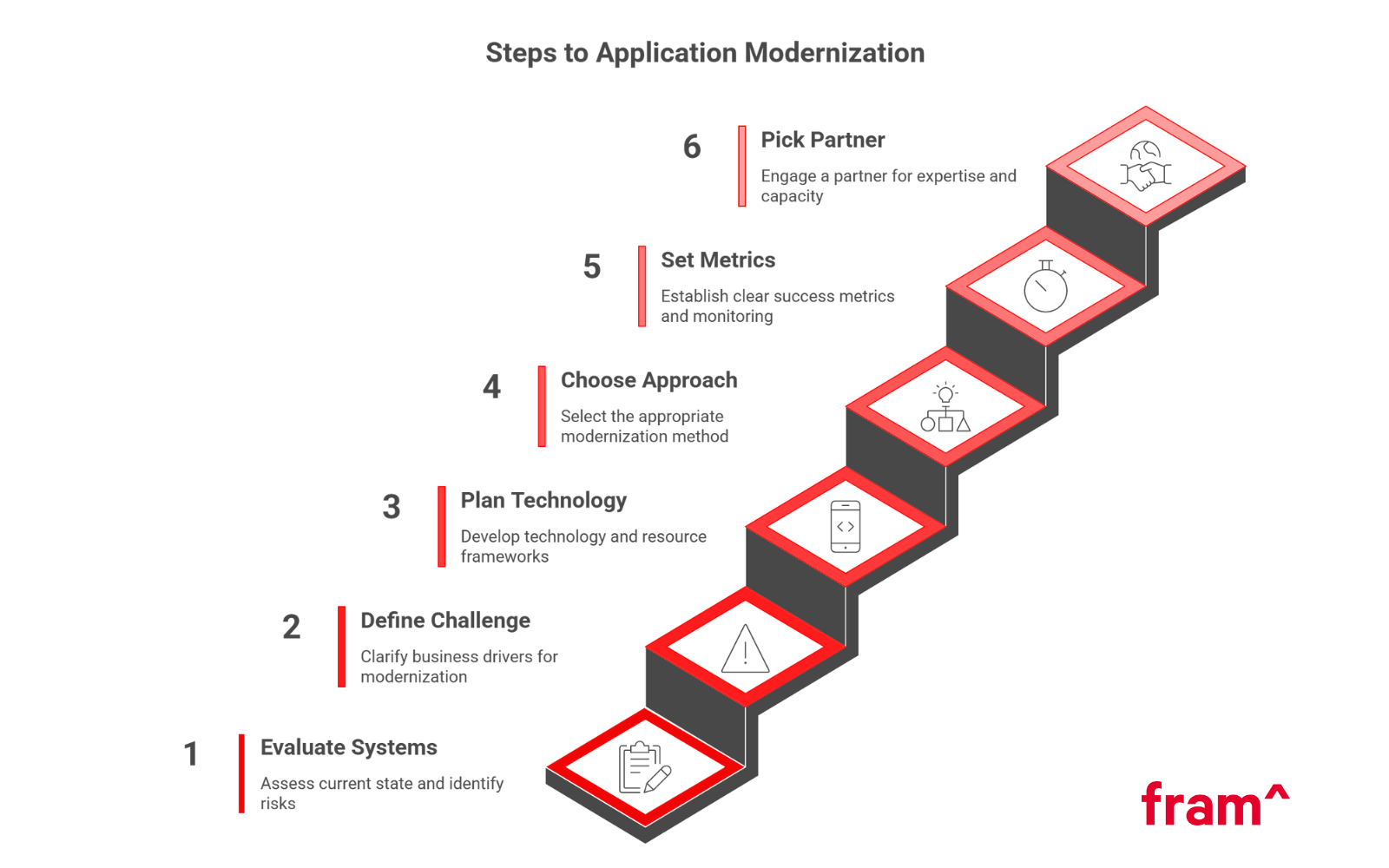
1: Evaluation and Assessment Stage of Legacy Systems
Start by assessing the current state. List all applications in the portfolio, rate them for business criticality, cost, technical debt, and scalability.
Identify applications with the highest risk or those blocking growth. This baseline creates the foundation for a future state roadmap.
Here’s a more tactical decision matrix to help you with this process:
You can use this to score each app from low to high, and prioritize those high ‘scores’ for all criteria except for migration difficulty.
Hopefully, this helps your decision-making:
Results
Action / Priority
Mostly High Scores
Modernize immediately
Mix of Medium + High
Good candidate for phased modernization
Mostly Medium
Leave for later; optimize selectively
Low + Medium
Low priority; consider replacing or retiring
2: Define Your Unique Business Challenge
Every organization has a different driver for modernization. It could be slow performance, compliance gaps, or an urgent need to support digital channels.
Writing a one-page challenge statement clarifies why modernization matters and what outcomes will define success.
3: Plan Out the Technology and Resources Frameworks
After identifying the challenge, create a plan for the technology stack and resources. Decide whether applications will move to microservices architectures, which cloud platforms will host them, and what DevOps practices will support delivery. Assign roles, budgets, and timelines so that execution is realistic.
4: Choose Your Modernization Approach
There is no single modernization method. Some workloads need a quick rehost to virtual machines in the cloud, while others demand a complete rebuild with cloud-native architectures.
The chosen path should match the expected lifespan of the application and the business goals it supports.
5: Identify Your Success Metrics and Monitoring Methods
Set clear metrics before the work begins. Common examples include deployment frequency, error rates, infrastructure cost savings, or time-to-market.
Monitoring tools should track both technical KPIs and business KPIs, ensuring that progress can be measured objectively.
6: Pick Your Ideal Modernization Partner
A partner brings experience, expertise, and thus extra delivery capacity. Framspecializes in application modernization, from replatforming legacy applications to designing microservices architectures.
Partnering with Fram reduces risk, accelerates execution, and frees internal teams to focus on business growth. Check out our case studies if you’d like to learn more!
Different Application Modernization Approaches You Should Know About
Modernization is not a single path. Each application has a different value, technical debt, and urgency. Choosing the right method depends on cost, risk, and alignment with business goals.
Below are the most common approaches, with more depth on when to use them:
Approach
What It Is
Best For
Pros
Cons
Rehost
Lift and shift apps to cloud virtual machines with minimal change.
Quick wins, data center exit, disaster recovery.
Fast, cheaper than on-prem, low disruption.
Legacy limits remain.
Refactor
Clean and restructure code while keeping core functions.
Apps are slowed by technical debt, but are still valuable.
Improves agility, performance, and security.
Slower than rehost, dev effort needed.
Replatform
Move apps to managed cloud services (e.g., Azure SQL, OpenShift).
Reduce admin work, extend app life.
Lower ops burden, access to cloud features.
Some code changes are required.
Rearchitect
Redesign app, often shifting from monolith to microservices.
Apps needing scale, flexibility, or new channels.
Independent scaling, faster releases.
Higher cost and complexity.
Rebuild
Rewrite the app from scratch with modern frameworks.
Legacy stacks are blocking progress or compliance.
Clean base, long-term maintainability.
High upfront investment.
Replace
Swap the custom app for an off-the-shelf product.
Non-core functions (e.g., HR, payroll).
Faster rollout, lower costs.
Less customization.
Repurchase
Move from licensed software to SaaS (e.g., Salesforce).
Cut maintenance, adopt SaaS features.
Subscription pricing, quick updates.
Reduced control, vendor lock-in.
Technology Options for App Modernization
Technology choices form the backbone of modernization. Each option impacts scalability, performance, and long-term flexibility. Below is a more detailed look at the main categories.
Databases
Modernization often starts with the database. Legacy databases can limit performance and security. Options include:
Managed Databases (Azure SQL Database, Amazon RDS, Google Cloud SQL): Lower admin effort, automated patching, and built-in backups.
Serverless Databases (Aurora Serverless, Cosmos DB): Ideal for unpredictable workloads; they scale automatically and reduce idle costs.
Modern NoSQL Stores (MongoDB Atlas, DynamoDB): Support for flexible schemas and high-volume workloads.
The choice depends on whether the app needs strong transactional consistency, real-time analytics, or simple key-value storage.
Cloud Computing
Selecting a cloud platform is central to modernization. Azure, AWS, and Google Cloud all provide global coverage, managed services, and compliance support.
Azure integrates well with Microsoft-heavy enterprises and services like Azure SQL and Azure DevOps.
AWS has the broadest service catalog and a mature ecosystem.
Google Cloud specializes in analytics and AI integration.
Hybrid cloud is common, combining private clouds for sensitive data with public cloud for elastic scaling.
Data Migration
Data migration is often the most delicate step. Tools like AWS Database Migration Service or Azure Database Migration Service help move schemas and data with minimal downtime.
Best practices include running parallel tests, using change data capture for near-zero downtime, and having rollback plans ready.
APIs and API-Based Architecture
APIs decouple systems, making modernization less disruptive. For example, wrapping legacy software with APIs allows new mobile apps to use old business logic.
Clear API contracts, versioning, and security policies keep integration manageable. Over time, APIs enable migration piece by piece instead of all at once.
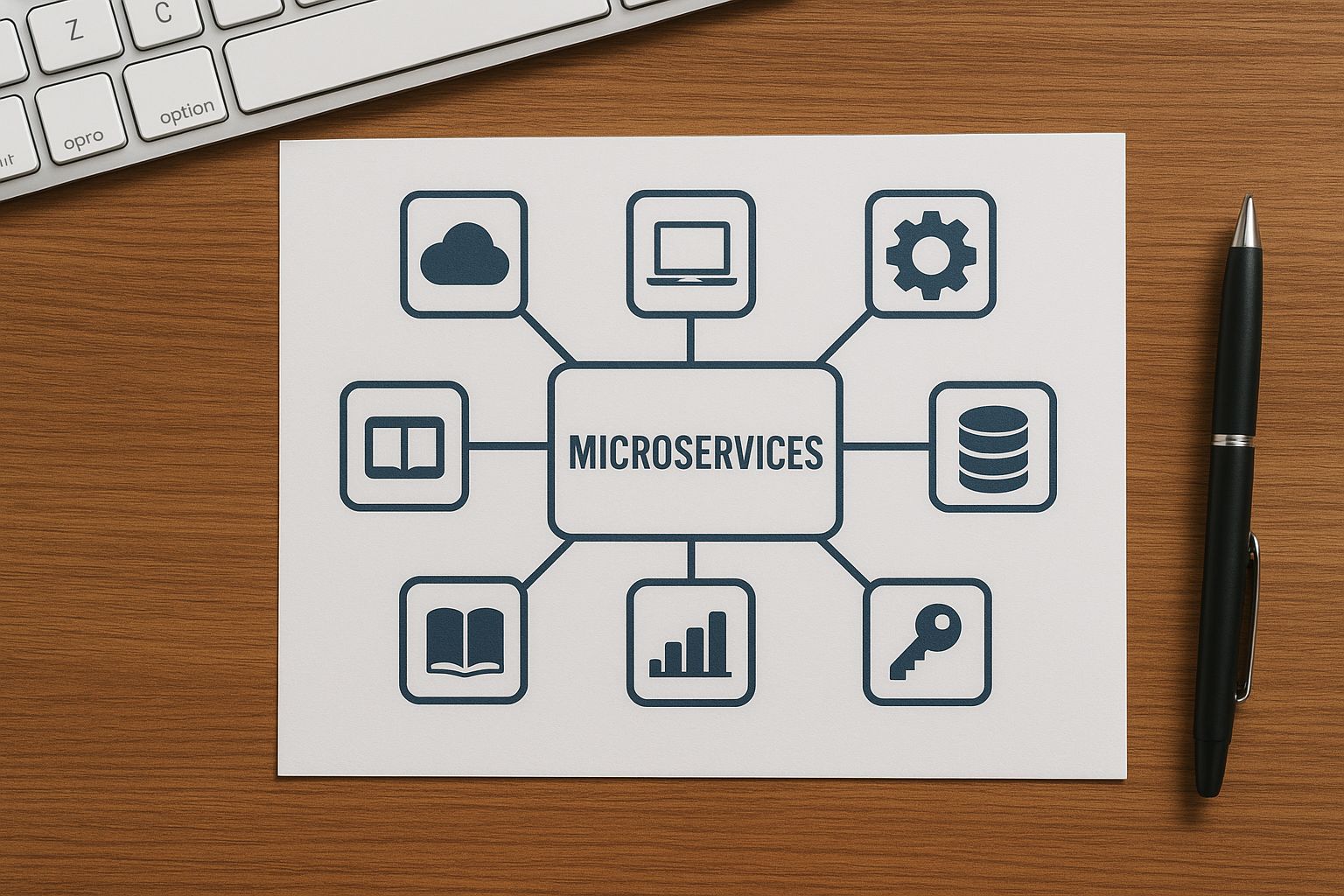
Microservices
Breaking applications into smaller services allows independent scaling, faster releases, and better fault isolation.
Each service handles a single business capability, supported by lightweight communication protocols like REST or gRPC. Microservices bring complexity, so they work best when domains are clear and teams are skilled in DevOps practices.
DevOps and CI/CD
Modernization succeeds when development and operations are integrated. Continuous Integration (CI) catches errors early, while Continuous Deployment (CD) automates safe releases. Adding automated security tests in the pipeline ensures compliance without slowing delivery.
Infrastructure Automation (IaC)
Teams can declare infrastructure as code using tools like Terraform, Bicep, or Pulumi. This makes environments repeatable, traceable, and version-controlled. IaC reduces manual errors and speeds up provisioning across multiple environments.
Containers and Kubernetes
Containers package applications into portable units. Kubernetes, along with Red Hat OpenShift, manages container orchestration, scaling, and monitoring.
Benefits include consistent environments, better resource use, and fast rollbacks. This model supports cloud-native architectures and future expansion into hybrid cloud models.
Types of Applications That Benefit Most from Modernization
The following applications show the clearest gains:
Monolithic Applications: Complex and slow to update; benefit from decomposition.
Customer-Facing Web Applications: Improve speed and customer experience.
Data-Intensive Applications: Gain performance from distributed databases and cloud computing.
Mobile Apps: Improve delivery speed through API-first design.
ERP Systems: Reduce cost and complexity by replatforming or adopting SaaS modules.
Limitations of Application Modernization
Modernization comes with its own challenges:
Initial Costs: Cloud migration, training, and refactoring require upfront investment.
Complexity: New stacks and cloud-native features introduce learning curves.
Downtime Risks: Data migration and system cutovers need careful testing and rollback plans.
Need Help With Your Application Modernization Strategy?
Modernization demands careful planning, technical skill, and steady execution. Fram brings proven expertise in cloud migration, microservices architectures, and Managed Services.
Our team can help you assess your current state, plan for a secure and scalable future state, and build cloud-native application development practices that fit your business goals.
Global spending on cloud migration services is projected to climb from about $232 billion USD in 2024 to more than $800 billion USD by 2029, a growth rate of around 28 percent annually. Surveys also show that over 90 percent of companies already run at least some workloads in the cloud, and many plan to […]
Mobile technology now spans devices, networks, software, sensors, cloud services, and AI. The stack powers how people work, shop, communicate, and access information on the move. Advances like 5G, edge computing, wearables, and on-device AI make mobile experiences faster, more personal, and more context-aware. Mobile is its own platform. It supports real-time assistance, camera-based interaction, […]
Software modernization transforms legacy systems to align with modern technology and business goals. More than an upgrade, modernization ensures scalable, secure systems that enhance customer experience. This guide explores the importance of legacy system modernization, its benefits, challenges, and the essential steps you should take to do it right! What is Software Modernization, and Why […]